
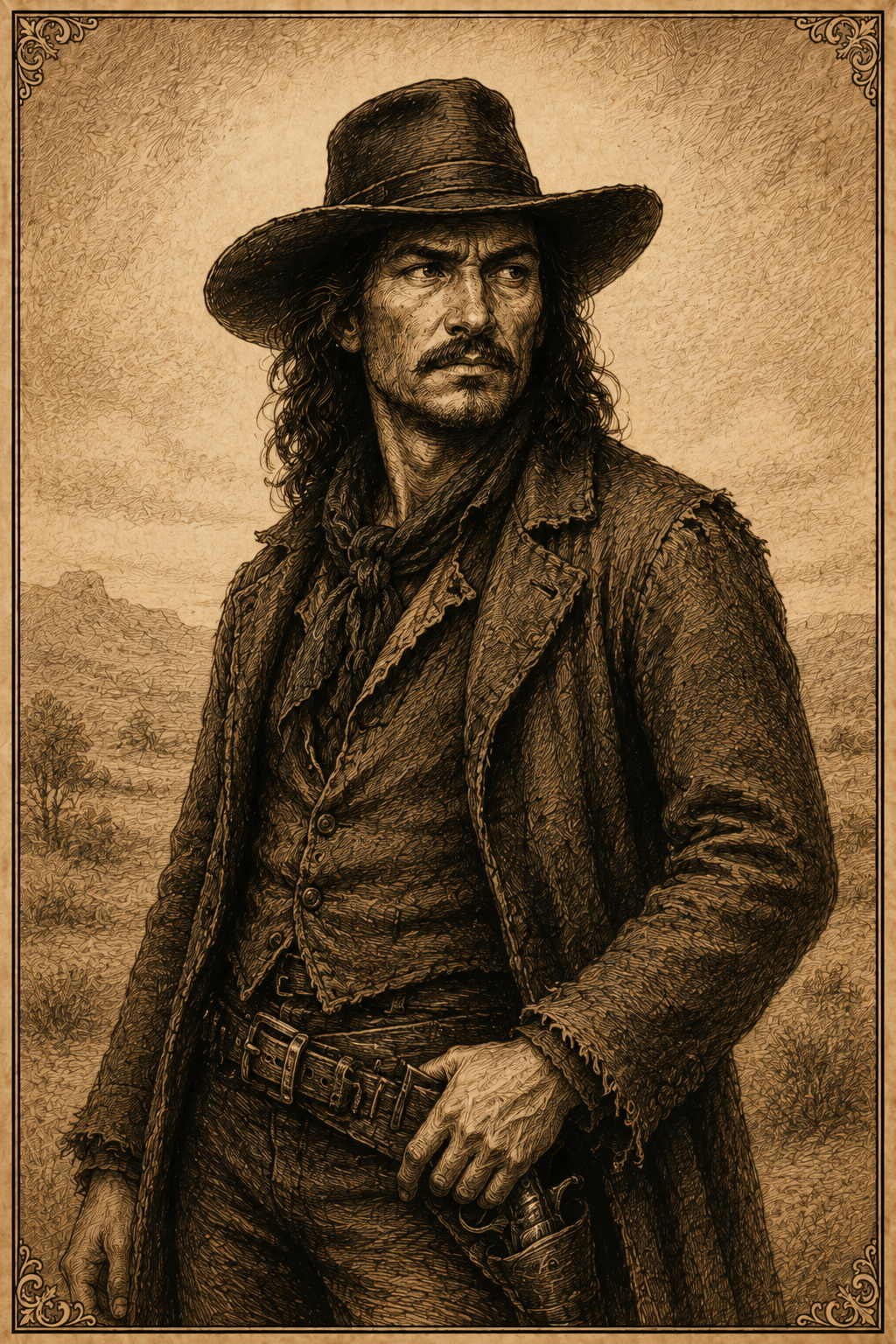
He belonged more to the borderlands and Indian Territory than to Texas itself — but folklore and fiction gave him a lasting place in the Texas imagination.
Featured illustration: an artistic representation of Blue Duck, not a historical photograph.
Listen to this article
This 5:10 audio version reads the article aloud. The full text below serves as the transcript.

Legend and record
Blue Duck is one of those frontier names that sounds almost invented.
That may be one reason the legend has survived so well.
Many Texans know the name through Western stories, popular retellings, and especially through later fiction. But once the legend is separated from the record, Blue Duck becomes a more complicated figure than most people assume.
The mythic Blue Duck is a monster of the plains: savage, elusive, and almost larger than life.
In modern Texas memory, the name is strongly tied to Larry McMurtry’s Lonesome Dove. That fictional Blue Duck became one of the most feared villains in Western storytelling. But that character should not be treated as a reliable portrait of the historical man.
That is where the record matters.
A borderlands outlaw
The historical Blue Duck is usually identified as Bluford “Blue” Duck, an outlaw with roots in the Cherokee Nation and stronger ties to Indian Territory than to Texas. He moved in the rough outlaw world of the borderlands — a world of cattle theft, fugitives, federal marshals, tribal jurisdictions, and hard country where law could be distant and violence close.
His Texas connection is indirect, but not meaningless.
Blue Duck became linked in popular memory to Belle Starr, who herself had strong Texas ties through the Dallas area, her marriage to Jim Reed, and the outlaw networks that stretched across Texas, Arkansas, Missouri, and Indian Territory.
One of the most famous surviving images of Blue Duck shows him in manacles beside Belle Starr at Fort Smith, Arkansas, before he was sentenced to death by Judge Isaac Parker in 1886. That photograph helped preserve his image, but it also helped blur the line between documented history and outlaw theater.
The myth says Blue Duck was one of the most terrifying killers ever to stalk the Texas frontier.
The true history is still grim, but more specific.
The crime and sentence
In 1884, Blue Duck was accused in the killing of Samuel Wyrick in the Flint District of the Cherokee Nation. That matters because the crime most closely tied to him did not happen deep in Texas; it happened in Indian Territory. Accounts place Blue Duck with William Christie when Wyrick was killed, and the case eventually brought Blue Duck before Judge Isaac Parker’s federal court at Fort Smith.
Judge Parker sentenced Blue Duck to hang.
That sentence became part of the legend, too.
Some versions make it sound as if Blue Duck slipped away from death through outlaw cunning. The better-documented version is less dramatic. His death sentence was commuted to life in prison, and he was sent to the penitentiary. Years later, after becoming seriously ill with tuberculosis, he was pardoned and released. He died shortly afterward in Oklahoma in 1895.
How Texas adopted the legend
So why include him in a Texas outlaw series at all?
Because Texas did adopt him — not so much through court records, but through storytelling.
The same borderland culture that produced Texas Rangers, cattle drives, outlaw ballads, and dime-novel gunmen also absorbed figures who were not neatly contained by state lines. Blue Duck moved through that wider world. His association with Belle Starr touches Texas history. His name later entered Texas imagination through Western fiction, especially Lonesome Dove, even though McMurtry’s fictional character should not be confused with the real man.
That is the caution at the heart of Blue Duck’s story.
The myth says he was a pure Texas outlaw of almost demonic evil.
The record says he was a real criminal from the Cherokee Nation and Indian Territory whose strongest connection to Texas came later — through Belle Starr, borderland memory, and Western legend.
Blue Duck’s story reminds us that Old West history does not always follow clean county lines or state borders.
Sometimes the legend rides farther than the man ever did.
And in Blue Duck’s case, Texas remembered the legend almost more than the record.
Sources used
- Encyclopedia of Arkansas — Belle Starr and Blue Duck image materials
- National Park Service — Belle Starr and Fort Smith history
- Oklahoma Historical Society / Chronicles of Oklahoma materials
- Legends of America — Bluford “Blue” Duck overview
- Texas Standard — Lonesome Dove historical accuracy discussion
- General Texas and Indian Territory outlaw history references
Follow The Alliance Gazette for more Texas history, forgotten stories, and the truth behind the legends.