
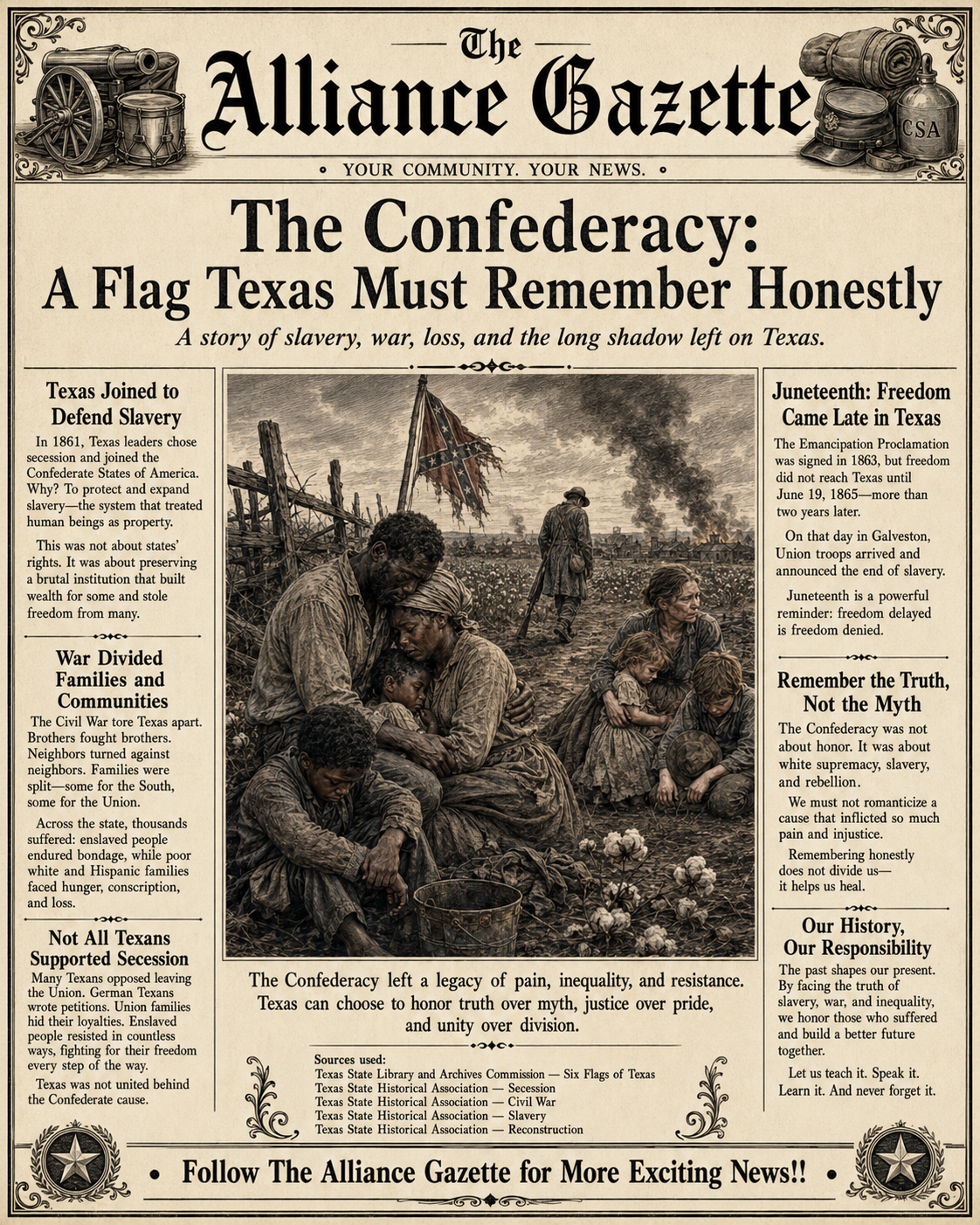
SIX FLAGS OF TEXAS | PART 5 OF 6
The Confederate flag is the hardest of the Six Flags to discuss — and it should be.
Historical note: The Confederacy used several national flags. The familiar diagonal-cross design was a battle flag and should not be confused with one official flag used everywhere. In the Six Flags tradition, the fifth sovereignty is the Confederate States of America.
Listen to this article
This 4:23 audio version reads the article aloud. The full text below serves as the transcript.

Why Texas joined the Confederacy
Texas seceded from the United States in 1861 and joined the Confederate States of America. Like other slaveholding states, Texas’s secession was tied directly to the defense of slavery, the cotton economy, and resistance to federal power.
That has to be said plainly.
Slavery at the center
By 1860, slavery was deeply woven into the Texas economy, especially in cotton-growing regions. Enslaved Black Texans built wealth for others while being denied freedom, wages, family security, movement, and legal personhood.
Secession was not an abstract political debate for them. It was an effort to preserve the system that held them in bondage.
Texas during the Civil War
Texas’s Civil War experience was different from states where major battles destroyed cities and farms, but the war still changed everything. Texas supplied soldiers, cattle, cotton, horses, military goods, and frontier defense forces to the Confederacy.
Its Gulf ports and the Rio Grande trade through Mexico became important to Confederate survival. Galveston saw major military action. Families were divided by conscription, loyalty, class, ethnicity, and geography.
Unionists, dissent and resistance
Not all Texans supported secession.
German Texans, Tejanos, Unionists, enslaved people, some frontier families, and others resisted or questioned the Confederate cause in different ways. Some paid with imprisonment, exile, violence, or death.
The war was not one unified Texas marching in one direction. It was a state under pressure, with deep internal divisions.
War on the frontier and home front
The Confederacy also weakened frontier defense. With federal troops gone and Confederate resources stretched, many frontier communities faced increased danger. The war pulled men away from farms, towns, ranches, and families. Inflation, shortages, fear, and grief reached far beyond the battlefield.
Emancipation and Juneteenth
The most important result came at the end.
On June 19, 1865, Union General Gordon Granger arrived in Galveston and announced freedom for enslaved people in Texas.
Juneteenth began there — not because freedom had just been created, but because it was finally being enforced in one of the last places where slavery had survived after the Civil War’s collapse.
The flag’s contested legacy
The Confederate period lasted only from 1861 to 1865, but its impact has lasted far longer. It reshaped Texas politics, race relations, labor, land ownership, memory, and public symbols.
Reconstruction that followed brought new possibilities and fierce backlash. The struggle over citizenship, voting rights, equality, and historical memory did not end with the lowering of the Confederate flag.
Remembering honestly
This flag should not be romanticized.
It should be understood.
The Confederate chapter of Texas history is a warning about what happens when a society builds wealth on human bondage and then goes to war to protect it.
Texas history is strong enough to tell the truth.
Sources used
- Texas State Library and Archives Commission — Six Flags of Texas
- Texas State Historical Association — Secession
- Texas State Historical Association — Civil War
- Texas State Historical Association — Slavery
- Texas State Historical Association — Reconstruction
- Texas State Historical Association — Mexican Texans in the Civil War
- Texas Historical Commission — Texas in the Civil War
- Kenneth W. Howell — The Seventh Star of the Confederacy: Texas during the Civil War
Follow The Alliance Gazette for more Texas history, forgotten stories, and local news told straight.