
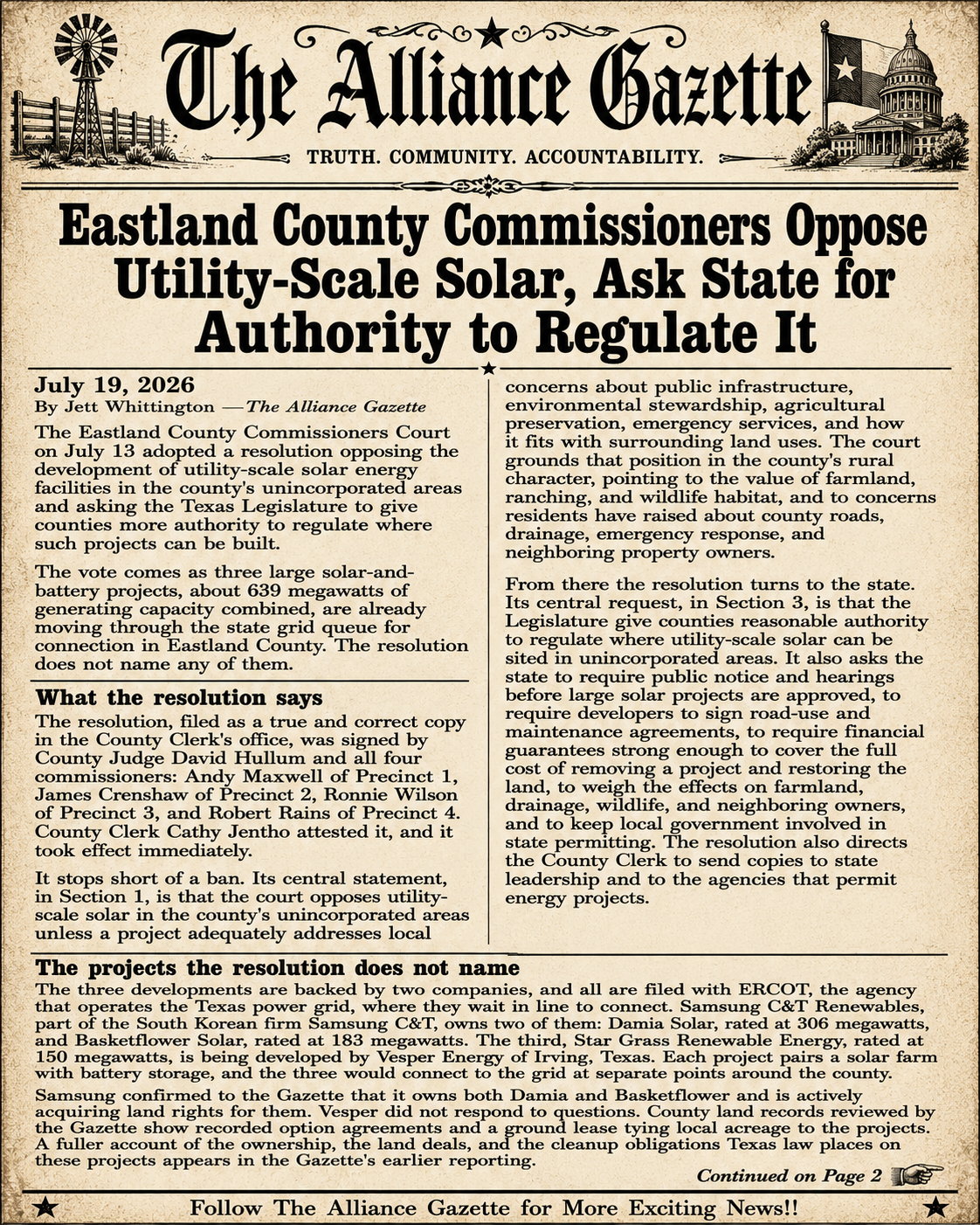
The court’s nonbinding July 13 resolution asks Texas lawmakers to give counties siting authority as three proposed solar-and-battery projects totaling 639 megawatts remain listed in ERCOT’s interconnection queue.
Listen to the article
Audio version — 6 minutes, 24 seconds. Controls are provided for this accessibility feature; playback does not start automatically.
The Eastland County Commissioners Court on July 13 adopted a nonbinding resolution opposing utility-scale solar energy facilities in the county’s unincorporated areas unless developers adequately address specified local concerns. The court also asked the Texas Legislature to give counties more authority over where such projects can be built.
The action comes as three proposed solar-and-battery developments totaling about 639 megawatts of solar generating capacity are listed in ERCOT’s interconnection queue for Eastland County. A queue listing is not project approval or proof that construction will occur, and the resolution does not name the projects.
What the resolution says
The resolution, filed as a true and correct copy in the County Clerk’s office, was signed by County Judge David Hullum and all four commissioners: Andy Maxwell of Precinct 1, James Crenshaw of Precinct 2, Ronnie Wilson of Precinct 3, and Robert Rains of Precinct 4. County Clerk Cathy Jentho attested it, and it took effect immediately.
It stops short of a ban. Its central statement, in Section 1, is that the court opposes utility-scale solar in the county’s unincorporated areas unless a project adequately addresses local concerns about public infrastructure, environmental stewardship, agricultural preservation, emergency services, and how it fits with surrounding land uses. The court grounds that position in the county’s rural character, pointing to the value of farmland, ranching, and wildlife habitat, and to concerns residents have raised about county roads, drainage, emergency response, and neighboring property owners.
From there, the resolution turns to the state. Its central request, in Section 3, is that the Legislature give counties reasonable authority to regulate where utility-scale solar can be sited in unincorporated areas. It also asks the state to require public notice and hearings before large solar projects are approved, require developers to sign road-use and maintenance agreements, require financial guarantees strong enough to cover the full cost of removing a project and restoring the land, weigh the effects on farmland, drainage, wildlife, and neighboring owners, and keep local government involved in state permitting. The resolution also directs the County Clerk to send copies to state leadership and the agencies that permit energy projects.
The projects the resolution does not name
The three developments are backed by two companies, and all are filed with ERCOT, the agency that operates the Texas power grid, where they wait in line to connect. Samsung C&T Renewables, part of the South Korean firm Samsung C&T, owns two of them: Damia Solar, rated at 306 megawatts, and Basketflower Solar, rated at 183 megawatts. The third, Star Grass Renewable Energy, rated at 150 megawatts, is being developed by Vesper Energy of Irving, Texas. Each project pairs a solar farm with battery storage, and the three would connect to the grid at separate points around the county.
Samsung confirmed to the Gazette that it owns both Damia and Basketflower and is actively acquiring land rights for them. Vesper did not respond to questions. County land records reviewed by the Gazette show recorded option agreements and a ground lease tying local acreage to the projects. A fuller account of the ownership, the land deals, and the cleanup obligations Texas law places on these projects appears in the Gazette’s earlier reporting.
Why the county is asking the state
The resolution’s central request — authority to regulate siting — reflects a real gap in Texas law. Texas counties generally lack broad zoning or siting authority in unincorporated areas and have few tools to control where industrial-scale development goes, leaving siting decisions for large solar projects largely outside local hands.
The Legislature considered closing part of that gap in its 2025 session. Senate Bill 819, filed by Sen. Lois Kolkhorst, would have created a state permitting process at the Public Utility Commission for new wind and solar projects of 10 megawatts or more, with setback rules, environmental review, and public-notice requirements. The bill passed the Senate, was referred to the House State Affairs Committee and did not become law. With no statewide siting process in place, counties such as Eastland are appealing to the state directly.
Solar has become a major part of the Texas grid. Federal Reserve Bank of Dallas analysis documents record solar generation and rapid battery growth in ERCOT, particularly during daytime demand.
What the resolution can — and cannot — do
The resolution carries weight as a formal statement of the county’s position, but it is important to be clear about what it does and does not accomplish. It is a nonbinding measure. It does not create new county authority, and it does not give the Commissioners Court the power to approve, deny, delay, or place conditions on the three projects now in the queue. Those projects move through ERCOT and state processes rather than county permitting, and nothing in the resolution changes that path.
Under current law, the county lacks broad siting authority over utility-scale solar in its unincorporated areas. That is the authority the resolution asks the Legislature to grant, and any change would require state action. Texas law separately establishes decommissioning and financial-assurance requirements for certain solar and battery projects through Senate Bill 760 from 2021, House Bill 3228 from 2025, and House Bill 3809 from 2025. The timing and terms of an individual facility agreement determine how those provisions apply.
In practical terms, the resolution records where the Commissioners Court stands and asks the state for tools the county does not currently have. On its own, it does not change whether or how the three projects proceed.
Print edition
The two print pages are stacked below in order. Open either page at full resolution to zoom and read the newspaper layout.


Sources and methodology
This report is based on the Eastland County Commissioners Court resolution adopted July 13, 2026, and the copy filed with the County Clerk; ERCOT interconnection-queue records; Eastland County real-property records; a written response from Samsung C&T Renewables; questions sent to Vesper Energy, with no response received by publication; and official Texas Legislature records for SB 819, SB 760, HB 3228, and HB 3809.
Follow The Alliance Gazette for local government reporting, public accountability, and news that matters to Eastland County.