
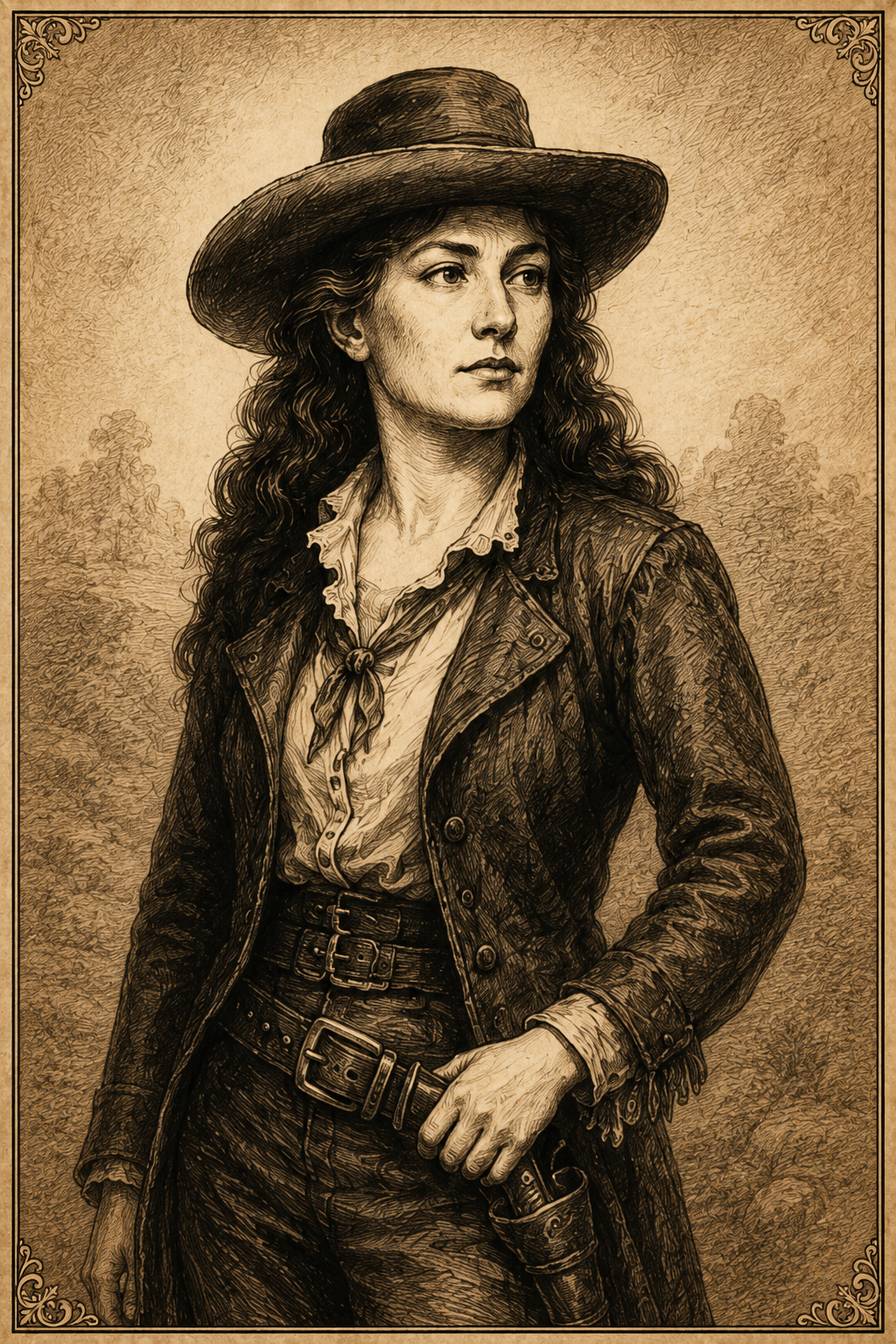
Belle Starr: How Texas Helped Make a “Bandit Queen”
Her legend grew into dime-novel royalty, but the real woman behind the title was far more complicated than the myth.
Belle Starr was born Myra Maybelle Shirley near Carthage, Missouri, in 1848. But Texas became one of the places that helped turn her from a frontier woman into one of the most famous outlaw legends in American history. After the Civil War, her family moved to Scyene, near Dallas, and from there Belle entered a world tied to Confederate guerrillas, horse thieves, fugitives, and men whose names already carried danger.
The myth of Belle Starr is larger than life.
She is often remembered as the “Bandit Queen,” a female Jesse James riding armed across the frontier, masterminding crimes, protecting outlaws, and ruling a criminal empire with glamour and nerve.
That is the story that stuck.
But the historical record is much less tidy.
Belle certainly lived around criminals. She married into outlaw circles. She knew dangerous men. She made choices that placed her near horse theft, fugitives, and frontier crime. But historians have long warned that there is no solid record proving she personally robbed banks, held up trains, committed murder, or carried out many of the spectacular crimes later attached to her name.
In other words, the legend says Belle Starr led from the saddle.
The record suggests something more complicated: a woman living inside violent networks whose fame grew through association, rumor, and sensational writing.
Her Texas connection is important.
In Texas, Belle married Jim Reed in 1866. Reed himself became tied to outlaw activity, and through that marriage Belle moved deeper into circles connected to horse theft, fugitives, and men who operated across Texas, Arkansas, Missouri, and Indian Territory.
Some stories claim Belle helped move or sell stolen horses through the Dallas area. Other accounts paint her as a criminal organizer. But this is where the historian has to slow down. The more dramatic the claim, the more carefully it has to be handled.
Belle Starr’s life sits right on the border between evidence and folklore.
One of the biggest myths around Belle is that she was the “female Jesse James” — a criminal mastermind equal to the most famous outlaws of the West.
That image came largely after her death.
In 1889, the same year Belle was murdered, publisher Richard K. Fox of the National Police Gazette released Bella Starr, the Bandit Queen, or the Female Jesse James. That dime-novel style title helped lock her into American memory as a glamorous outlaw queen, whether or not the facts could support the crown.
The public loved the idea.
A dangerous woman.
A pistol.
A horse.
A mysterious death.
A frontier full of wanted men.
It was almost too perfect for the newspapers and dime novels to resist.
But Belle’s real life was not clean legend. It was messy, violent, and often tragic.
After Jim Reed’s death, Belle later married Sam Starr in the Cherokee Nation. She did face real legal trouble. Belle and Sam were convicted of horse theft in federal court under Judge Isaac C. Parker at Fort Smith, and Belle served time in the House of Correction in Detroit. That part of the record is not myth.
Still, even that conviction does not make her the criminal queen that later writers imagined.
It shows something more human and more historically believable: Belle Starr was not outside the outlaw world looking in. She was part of it. But the world later exaggerated her role because the story sold better that way.
Then came the ending that made the legend permanent.
On February 3, 1889, Belle Starr was shot from ambush near her home in Indian Territory. She died just days before her forty-first birthday. No one was convicted of her murder.
That unsolved death gave the myth everything it needed.
A famous outlaw woman.
A hidden killer.
A frontier grave.
No final answer.
Belle Starr’s story became bigger after she died than it had ever been while she lived.
That is the heart of her legend.
Texas did not create Belle Starr alone, but Texas helped shape the world that made her famous. Her years near Dallas, her marriage to Jim Reed, and her connection to outlaw networks gave later writers the raw material they needed. Then newspapers, dime novels, and public imagination did the rest.
The myth says Belle Starr was a female criminal mastermind.
The truth is more interesting.
Belle Starr was a woman caught in the violent borderlands of Texas, Missouri, Arkansas, and Indian Territory — close enough to crime to become notorious, mysterious enough to become marketable, and famous enough for legend to outrun the record.
She was not the simple “Bandit Queen” of dime-novel fantasy.
She was something harder to pin down.
And that may be exactly why her story has survived.
Sources used:
Texas State Historical Association — Myra Maybelle Shirley Starr
Encyclopedia of Arkansas — Belle Starr
Oklahoma Historical Society — Belle Starr
Humanities Texas — Belle Starr
Library of Congress / frontier-era press and dime-novel context
Follow The Alliance Gazette for more Texas history, forgotten stories, and the truth behind the legends.