
TRUTH. COMMUNITY. ACCOUNTABILITY.
THE JOURNALIST ON THE QUARTER
More than a century ago, Jovita Idár used a small Texas newspaper to challenge injustice, defend her community, and insist that ordinary people deserved a voice.
Sometimes history doesn’t announce itself.
Sometimes it lands in your pocket.
Earlier today, two quarters were sitting side by side. One looked familiar. The other didn’t.
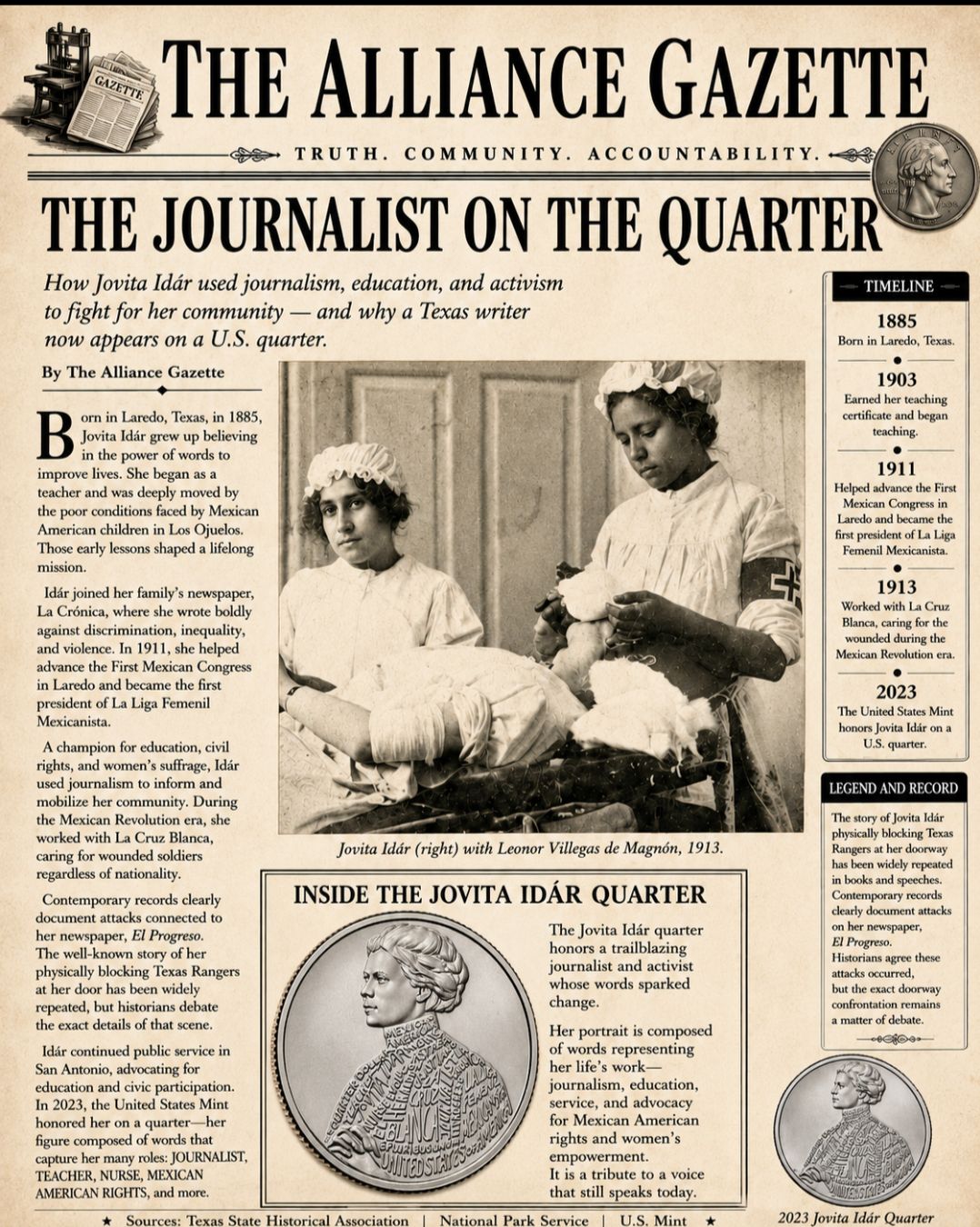
On the reverse of the unusual quarter was the image of a woman. But when you looked closer, her clothing appeared to be made from words:
- JOURNALIST.
- TEACHER.
- NURSE.
- MEXICAN AMERICAN RIGHTS.
- LA CRÓNICA.
- EL PROGRESO.
Her name was Jovita Idár.
For those of us who still believe local journalism matters, her story is worth telling. Because long before social media, television news, or the internet, Idár understood something journalists are still wrestling with today: a printing press in the hands of people willing to use it can give a community a voice.
JOVITA’S EARLY LIFE
Jovita Idár was born in Laredo, Texas, on September 7, 1885, into a family deeply involved in journalism and civic affairs. Her father, Nicasio Idár, published the Spanish-language newspaper La Crónica.
But journalism wasn’t where Jovita started. She became a teacher. After earning her teaching certificate in 1903, she taught in Los Ojuelos, a small community in Webb County. There, she encountered the poor conditions facing Mexican American students, where schools often lacked adequate equipment, resources, and support.
Idár ultimately concluded that she could not create the change she wanted from inside the classroom alone. So she left teaching and picked up a pen.
THE FAMILY NEWSPAPER
Jovita joined her father and brothers at La Crónica. The newspaper did far more than report local happenings. It wrote about discrimination against Mexican Americans, economic hardship, education, the preservation of Mexican culture and language, and violence against people of Mexican descent.
At a time when publicly challenging powerful institutions could carry very real consequences, the Idár family put those subjects into print. It is easy, more than a century later, to romanticize old newspapers. But publishing criticism in South Texas during the early 1900s was not the equivalent of posting an angry comment online.
Your name was attached to the ink. Your office had an address. And the people you criticized knew exactly where the printing press was. Yet Jovita kept writing.
WHEN JOURNALISM BECAME ORGANIZING
In 1911, La Crónica helped bring together what became known as the First Mexican Congress in Laredo. Mexican Americans gathered to discuss education, labor conditions, economic inequality, discrimination, and other problems affecting their communities. Women were not simply spectators. They participated. And Jovita Idár was among them.
From that movement came La Liga Femenil Mexicanista — the League of Mexican Women. Idár became its first president. One of the organization’s major goals was practical and immediate: improving educational opportunities for poor children. Idár also supported women’s suffrage years before the Nineteenth Amendment guaranteed women the right to vote nationwide. To her, journalism, education, women’s participation in public life, and civil rights were connected. If people could read, organize, speak, and publish, they could demand something better.
THEN SHE CROSSED INTO A WAR
Her work wasn’t confined to a newsroom. During fighting connected to the Mexican Revolution in 1913, Idár crossed from Texas into Nuevo Laredo to help care for the wounded. She later became involved with La Cruz Blanca — the White Cross — providing medical assistance in northern Mexico. Then she returned to journalism.
And this is where one of the most famous stories about her begins. It is also where responsible historians have to be careful.
JOVITA IDÁR AND THE TEXAS RANGERS
For decades, an extraordinary story about Jovita Idár has been repeated. According to later family recollections, Texas Rangers arrived at the newspaper El Progreso intending to shut it down. The story says Jovita stood in the doorway and refused to let them enter. The Rangers supposedly withdrew, returned when she was gone, and destroyed the newspaper’s equipment.
It is a powerful story. But historical research has raised questions about whether the confrontation happened exactly that way. Contemporary newspaper accounts do document a very real attack involving El Progreso in 1916. Editor Leo D. Walker was arrested on a criminal-libel charge. A civilian group later kidnapped Walker, forced him across the Rio Grande, damaged a printing press, and ordered the newspaper to stop publishing. What contemporary records do not clearly document is the famous scene of Jovita standing alone in a doorway against Texas Rangers.
The better-known version appears largely in family recollections recorded many years later. That does not necessarily prove every element of the story is false. But it means we should not present the doorway confrontation as unquestioned fact. And perhaps that is fitting. Because Jovita Idár doesn’t need a legend. The documented history is remarkable enough.
LEGACY CONTINUES
She really did write against discrimination. She really did organize women. She really did advocate for better education. She really did support women’s political participation. She really did cross an international border to care for people wounded in war. She really did work for newspapers willing to print controversial positions. And El Progreso really was attacked and its printing equipment damaged amid political conflict. Those aren’t legends. Those are history.
After El Progreso ceased publishing, Idár returned to La Crónica. Following her father’s death, she helped operate the newspaper. In 1916, she and her brother Eduardo also established another publication, Evolución, where they continued advocating for women’s participation in political life. Jovita married Bartolo Juárez in 1917 and eventually moved to San Antonio. But leaving Laredo did not end her public service.
In San Antonio, she remained politically and socially active, helped establish a free kindergarten, worked as an interpreter assisting Spanish-speaking hospital patients, and served as an editor for the Methodist publication El Heraldo Cristiano. She continued serving her community until her death in 1946.
For decades afterward, much of America barely knew her name. Then, more than a century after she first entered a newsroom, something remarkable happened.
THE JOURNALIST BECAME AMERICAN CURRENCY
In 2023, the United States Mint placed Jovita Idár on a quarter as part of the American Women Quarters Program. And the designers did something extraordinary. Look closely at the coin. Her clothing isn’t simply clothing. It is made from words:
- MEXICAN AMERICAN RIGHTS
- TEACHER
- NURSE
- JOURNALIST
- LA CRÓNICA
- EL PROGRESO
- EVOLUCIÓN
- LA LIGA FEMENIL MEXICANISTA
- LA CRUZ BLANCA
The United States Mint literally constructed Jovita Idár’s image from the causes, organizations, and newspapers that helped define her life. Suddenly, that strange-looking quarter makes perfect sense.
A MODERN REFLECTION
There is something almost poetic about discovering Jovita Idár by accident. She wasn’t a president. She wasn’t a general. She didn’t command an army or run a massive corporation. She was a Texas teacher who looked at the conditions around her and decided they weren’t acceptable. Then she became a journalist.
She wrote. She organized. She educated. She served. And she learned something generations of community journalists have learned since: Sometimes the most powerful person in the room isn’t the government official, the wealthy businessman, or the person with the grandest title. Sometimes it’s the person with a notebook asking a question. Sometimes it’s a small newspaper willing to print the answer.
More than a century separates Jovita Idár’s La Crónica from The Alliance Gazette. The technology is different. The communities are different. The world is different. But the responsibility of local journalism hasn’t changed very much: listen to the people nobody is listening to, ask the questions others aren’t asking, put the facts on the record, and don’t be afraid of where those facts lead.
Today, Jovita Idár’s printing press has fallen silent. But the journalist herself is traveling through America millions of pockets at a time. And today, completely by chance, one of those quarters found its way into ours. Maybe that was reason enough to tell her story.
— The Alliance Gazette
TRUTH. COMMUNITY. ACCOUNTABILITY.
Sources consulted for this history include the Texas State Historical Association, National Park Service, and United States Mint.
#TexasHistory #JovitaIdar #TexasJournalism #TheAllianceGazette #LocalJournalism #WomenInHistory #AmericanWomenQuarters